After all the rain and mild weather, to wake up to even a light dusting of snow came as a bit of a shock this morning.
It is amazing how a little snow can transform the garden
Skye was more interested in Sue's miniature snowman...
... and seeing how much she could eat (as usual!)
Sunday, 17 January 2016
Thursday, 31 December 2015
Climping In Winter
Well what passes for winter at the moment - a very windy day but not very cold.
The wind caught Skye's ears!...
...but she enjoyed herself.
The wind caught Skye's ears!...
...but she enjoyed herself.
Wednesday, 18 November 2015
Bethnal Green Memorial
A crowd of people entered Bethnal Green tube station which
was used at the time as an air-raid shelter. After the searchlights went on and
an anti-aircraft battery a few hundred yards away in Victoria Park launched a
salvo of a new type of anti-aircraft rockets the crowd surged forward. Someone
tripped on the stairs causing many others to fall. 300 people were crushed into
the stairwell within a few seconds, 173 of them died and over 90 were injured.
The worst civilian disaster of the 2nd World War. For more about the history go to Stairway to Heaven Memorial
The memorial was
designed by local architect Harry Paticas. It is nearly complete and
just needs the teak ‘stairway’ that will go on the top. The inverted stairs will house 173 small
conical light shafts that will allow sunlight to shine through, each one
representing a person who died.
Sunday, 8 November 2015
Buchan Park
Autumn colours past their best and a dull November afternoon, nevertheless Skye enjoyed her walk, because she found a ball!
Look what I've found..
Well come on pick it up..
If I look cute and ready to chase, please throw it..
So I did but as i can't multi-task there are no more photos.
Look what I've found..
Well come on pick it up..
If I look cute and ready to chase, please throw it..
So I did but as i can't multi-task there are no more photos.
Saturday, 24 October 2015
Jersey in the rain
The first serious rain for quite a while coincided with my first visit to Jersey (one day last week). After completing work by early afternoon I had contemplated a few hours in the sunshine sightseeing. Reality was about an hour and a half in the rain in St Helier before I gave up and caught the bus back to the airport.
After quite a good fish and chips (with mushy peas) and an excellent pint of "Liberation ale" at The Peirson in Royal Square, I went out and took a photo of ...Royal Square. The Peirson is in the background ( grey to the left, - the pub directly behind the statue is the Cork and Bottle).
This was the marketplace until 1751 when it was renamed 'Royal Square' in honor of George II who had given £200 towards the construction of a new harbour. The gilded lead statue of George II is by John Cheere. It stands on a granite plinth close to where the old market cross stood until the Reformation. All distances in the island are measured from this statue.
As a stone in the square says...
.. that this was the site of The Battle of Jersey on 6 January 1781; the last attempt by French forces to seize Jersey. The battle is often remembered for the death of the British officer Major Francis Peirson who was in command of the British troops who defeated the French invasion force...hence The Peirson where I had lunch.
Also in the square is a self explanatory memorial...
...commemorating the announcement of the liberation of Jersey at the end of the Second world War.
Close to Royal Square is the Central Market, also with a plaque explaining its origin:
The Central Market, a Victorian cast iron market hall was opened in 1882 as a result of the stalls being banished from the Royal Square in 1800. It was worth a visit to see the the recently restored central fountain, and for the colourful array of fruit, vegetables and flowers around the fountain.
A view up the road from the market with No 1 King Street, home to the jewelers, Hettich, since 1900 with the front (or rear which ever way you look at it) of the Cork and Bottle and the Chambre des Etats further on.
The public entrance to the Chambre des Etats (States Chamber).
The building was opened on 21 June 1887, the 50th anniversary of Queen Victoria’s accession to the throne. The States Assembly meets here.
The Parish Church of St Helier is one of the twelve 'Ancient Parish Churches' of Jersey,
Although the church is some way inland today, this is a result of land reclamation and it once lay on the shore. The present church was begun in the 11th century although all that is visible of the 11th century structure are the remains of window arches on either side of the Choir. The church building was extended to roughly its present size by the end of the 12th century, but most of that building is also lost.
One striking sculpture in the North Transept is the 'The Blue Madonna' by John Robinson. It is a cast of Michelangelo's Pitti Tondo
The Toad - best explained by an extract from The Islandwiki
'A monument was erected at Charing Cross in St Helier in 2004, as part of the commemoration of the octocentenary of Jersey's status of Crown Dependency, and in memory of the presence on the site between 1698 and 1812 of the island's prison. The monument, created by Gordon Young, consists of a 9-foot tall column of polished Jersey granite into which is carved extracts from the Code Le Geyt of 1698 concerning crimes and applicable punishments. On top of the column is a Jersey crapaud - the site was originally marsh land, and the numerous toad colonies in the area are the source of the nickname commonly applied to Jersey people.'
Finally a walk in the rain to Liberation Square
At the centre of the Square is Philip Jackson’s sculpture depicting a group holding the Union Flag at the centre of a fountain. Twelve water jets in the pool symbolise Jersey's 12 parishes.
After quite a good fish and chips (with mushy peas) and an excellent pint of "Liberation ale" at The Peirson in Royal Square, I went out and took a photo of ...Royal Square. The Peirson is in the background ( grey to the left, - the pub directly behind the statue is the Cork and Bottle).
This was the marketplace until 1751 when it was renamed 'Royal Square' in honor of George II who had given £200 towards the construction of a new harbour. The gilded lead statue of George II is by John Cheere. It stands on a granite plinth close to where the old market cross stood until the Reformation. All distances in the island are measured from this statue.
As a stone in the square says...
.. that this was the site of The Battle of Jersey on 6 January 1781; the last attempt by French forces to seize Jersey. The battle is often remembered for the death of the British officer Major Francis Peirson who was in command of the British troops who defeated the French invasion force...hence The Peirson where I had lunch.
Also in the square is a self explanatory memorial...
...commemorating the announcement of the liberation of Jersey at the end of the Second world War.
Close to Royal Square is the Central Market, also with a plaque explaining its origin:
The Central Market, a Victorian cast iron market hall was opened in 1882 as a result of the stalls being banished from the Royal Square in 1800. It was worth a visit to see the the recently restored central fountain, and for the colourful array of fruit, vegetables and flowers around the fountain.
A view up the road from the market with No 1 King Street, home to the jewelers, Hettich, since 1900 with the front (or rear which ever way you look at it) of the Cork and Bottle and the Chambre des Etats further on.
The public entrance to the Chambre des Etats (States Chamber).
The building was opened on 21 June 1887, the 50th anniversary of Queen Victoria’s accession to the throne. The States Assembly meets here.
The Parish Church of St Helier is one of the twelve 'Ancient Parish Churches' of Jersey,
Although the church is some way inland today, this is a result of land reclamation and it once lay on the shore. The present church was begun in the 11th century although all that is visible of the 11th century structure are the remains of window arches on either side of the Choir. The church building was extended to roughly its present size by the end of the 12th century, but most of that building is also lost.
One striking sculpture in the North Transept is the 'The Blue Madonna' by John Robinson. It is a cast of Michelangelo's Pitti Tondo
The Toad - best explained by an extract from The Islandwiki
'A monument was erected at Charing Cross in St Helier in 2004, as part of the commemoration of the octocentenary of Jersey's status of Crown Dependency, and in memory of the presence on the site between 1698 and 1812 of the island's prison. The monument, created by Gordon Young, consists of a 9-foot tall column of polished Jersey granite into which is carved extracts from the Code Le Geyt of 1698 concerning crimes and applicable punishments. On top of the column is a Jersey crapaud - the site was originally marsh land, and the numerous toad colonies in the area are the source of the nickname commonly applied to Jersey people.'
Finally a walk in the rain to Liberation Square
Liberation
Square was developed in 1995 to mark the 50th Anniversary of Jersey's
Liberation. To the north of the square stands the Pomme D’Or Hotel, which was
used by the Nazis as their Headquarters during the Occupation. The hotel's
original balcony was the focal point for celebrations when the island was
liberated by British forces on May 9, 1945.
At the centre of the Square is Philip Jackson’s sculpture depicting a group holding the Union Flag at the centre of a fountain. Twelve water jets in the pool symbolise Jersey's 12 parishes.
Saturday, 10 October 2015
Emmetts garden and Knole
Nice October day (so the weather forecast said but it was actually overcast with only an occasional glimpse of the sun). We decided to visit Emmetts Garden near Sevenoaks but due to the mist and as the garden was not at its best now, we then headed to Knole.
Emmetts Garden
Wikepedia :
Emmetts Garden was open farmland until 1860 when the present house was built. The name 'emmett' is a local word for ant and refers to the giant anthills that covered the area until the 1950s. The house and land was purchased in 1890 by Frederic Lubbock, a banker and passionate plantsman. Lubbock's elder brother was John Lubbock, 1st Baron Avebury, coincidentally a world expert on ants, which may have influenced his decision to purchase the property.
The gardens were initially laid out between 1893 and 1895 under the influence of Lubbock's friend William Robinson in the fashionable Edwardian style popularised by Gertrude Jekyll. The shrub garden was added later in 1900-1908.
After Lubbock's death (1927), the estate was acquired by an American geologist Charles Watson Boise. He made various alterations to both house and garden but retained the original character of the gardens.
In 1964 Charles Boise bequeathed Emmetts to the National Trust.
...but the Rose garden was definitely past its best albeit there were a few bees around.
Unfortunately this was the view over the Weald towards Bough Beech Reservoir - very misty.
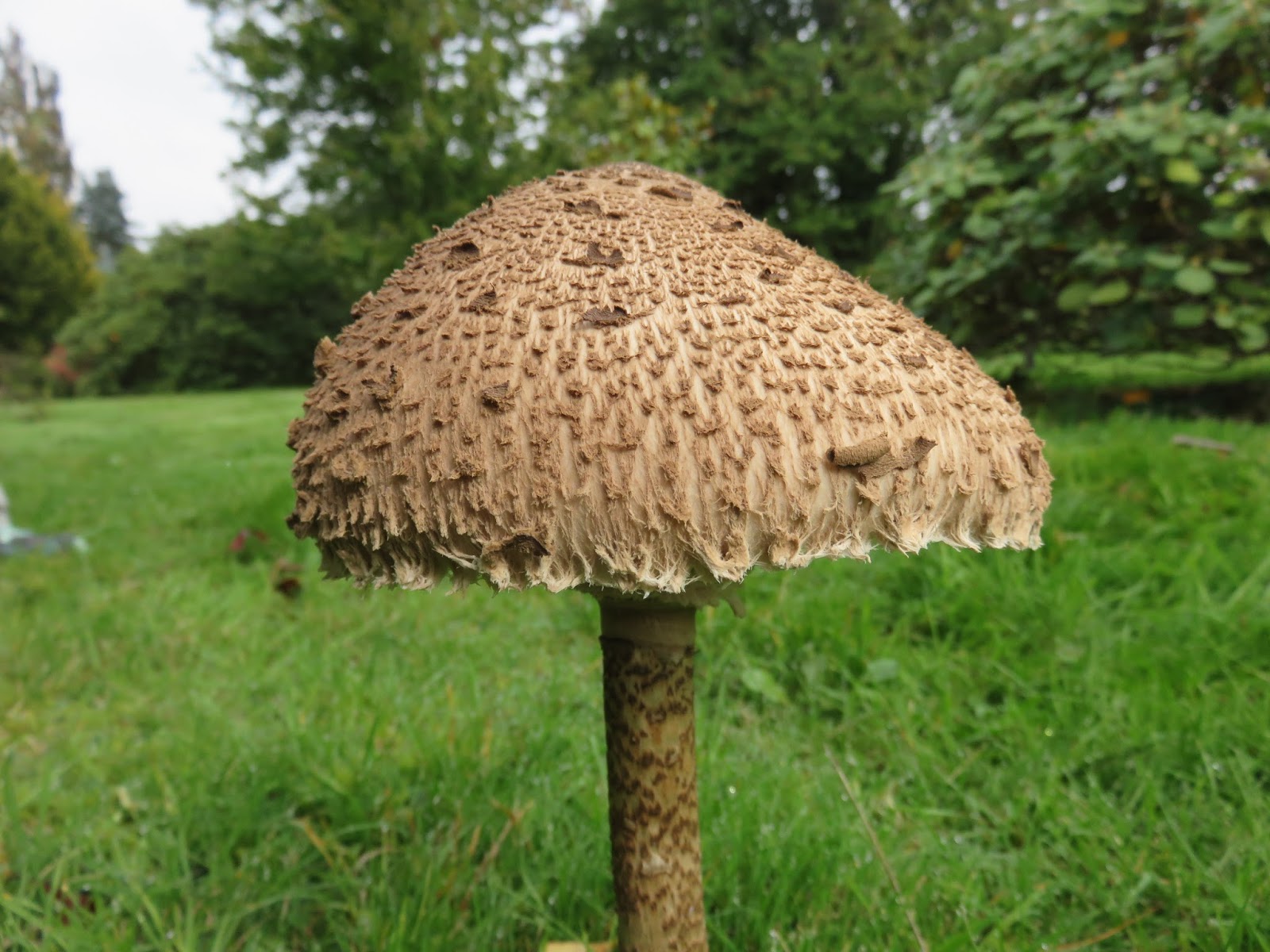
However we did see some fascinating mushrooms on the lawn in the South Garden.
We decided to go to Knole via Ide Hill - St Mary's Church was built in 1865 and is the highest church in Kent according to Wikepedia.
An attractive timber boarded House on the green.
And so to Knole.
Wikededia:
Emmetts Garden
Wikepedia :
Emmetts Garden was open farmland until 1860 when the present house was built. The name 'emmett' is a local word for ant and refers to the giant anthills that covered the area until the 1950s. The house and land was purchased in 1890 by Frederic Lubbock, a banker and passionate plantsman. Lubbock's elder brother was John Lubbock, 1st Baron Avebury, coincidentally a world expert on ants, which may have influenced his decision to purchase the property.
The gardens were initially laid out between 1893 and 1895 under the influence of Lubbock's friend William Robinson in the fashionable Edwardian style popularised by Gertrude Jekyll. The shrub garden was added later in 1900-1908.
After Lubbock's death (1927), the estate was acquired by an American geologist Charles Watson Boise. He made various alterations to both house and garden but retained the original character of the gardens.
In 1964 Charles Boise bequeathed Emmetts to the National Trust.
The Rock garden was looking quite good...
...but the Rose garden was definitely past its best albeit there were a few bees around.
Unfortunately this was the view over the Weald towards Bough Beech Reservoir - very misty.
However we did see some fascinating mushrooms on the lawn in the South Garden.
We decided to go to Knole via Ide Hill - St Mary's Church was built in 1865 and is the highest church in Kent according to Wikepedia.
An attractive timber boarded House on the green.
And so to Knole.
Wikededia:
Knole is one of England's largest houses, the National Trust
attribute a possibility of its having at some point been a calendar house which
had 365 rooms, 52 staircases, 12 entrances and seven courtyards. Its grade I
listing reflects its mix of Elizabethan to late Stuart structures, particularly
in the case of the central façade and state rooms. The surrounding deer park
has also survived with little having changed in the 400 years since 1600,
although its formerly dense woodland has not fully recovered from the loss of
over 70% of its trees in the Great Storm of 1987.
The deer were quite approachable.
Subscribe to:
Posts (Atom)